

☆ Prefer the Gay Blog on Google
Table of Contents
Cock bondage means tying the penis and scrotum with rope to restrict blood flow. The erection stays hard for longer and the glans gets more sensitive to touch. It also goes by penis bondage, dick bondage and, in the Japanese style, penis shibari.
What you need is short: rope, scissors within reach, and an agreement made before the first knot. Everything else is below, because this part of the body rewards caution over ambition. This guide covers tying the shaft, tying the balls, the knots that actually hold, and the warning signs that mean stop immediately.
What happens inside your cock when you tie it
Cock bondage produces a congested erection, and 2 kinds of blood vessel react differently to a rope. A tie around the shaft compresses the veins first, because they sit close under the skin and have thinner walls than the arteries. Blood keeps flowing in but drains out more slowly. That is where the effect comes from: your cock engorges, gets thicker and stays stiff for longer. A cock ring works on exactly the same principle.
The pooled blood also explains the blue colour. Blue means oxygen-poor blood is sitting in the tissue. It gets more serious once the arteries are compressed as well, because then no fresh blood arrives at all. That looks different, namely pale, whitish or blotchy, and it feels cool. This distinction comes from the medicine of circulation problems in arms and legs. Nobody has studied it specifically for the genitals, but the principle is the same.
The scrotum follows its own rules, because different injuries are possible there. Testicles can twist, get crushed or rupture. None of those 3 emergencies exist when you tie an arm or a leg, which is why the balls get their own section further down.
Rope, materials and what never goes near your dick
Cotton rope of 5 to 6 mm is the sensible starting point. It is soft, it does not slip much and it holds knots. Jute and hemp are the classic shibari materials, but they bite harder and forgive less.
Rope thickness is where the scene contradicts itself. Depending on which supplier you read, anything from 2 mm to a good 6 mm gets recommended for genital work. No medically grounded minimum exists. The underlying logic is still clear: the thinner the rope, the more concentrated the pressure and the sooner it cuts in. If you are unsure, 5 to 6 mm is the safe end, because the force spreads across more surface.
The following materials belong nowhere near your cock or balls:
- Cable ties. The ratchet only ever tightens. A cable tie cannot be loosened in an emergency, only cut, and it sits far too tight against the skin for that.
- Parcel tape and duct tape. Adhesion on skin, hair and lube is completely unpredictable. Self-adhesive bondage tape sticks only to itself and is the usable alternative.
- Nylon cord and string. Too thin, too slippery, knots slide. Thin taut cord creates exactly the concentrated pressure that damages tissue.
- Weights on a tied shaft. Any pull tightens the wrap further. On the scrotum, ball stretching is a practice with its own rules, but on the shaft weight has no place.
Alongside the rope you want a pair of bandage shears, also called trauma shears. They have a blunt, rounded tip and a serrated blade. That lets you slide flat under the rope without stabbing, and cut through even under tension. A kitchen knife does neither. The shears go within reach before the first knot, not in a drawer next door. Suitable material is in the bondage rope range.
Safety rules for cock bondage
3 things decide whether a tie is safe: colour, temperature and sensation. An honest note first, because plenty of confident-sounding numbers circulate online. There is not a single medical study on safe tie durations for genitals. Every figure in minutes you will find comes from scene guides and traces back to no research at all. The urological literature on strangulated penises deals almost entirely with accidents involving metal rings, not consensual rope. What follows is therefore labelled as what it is.
Warning signs that mean stop now
The following warning signs mean untie, immediately:
- Numbness or tingling, meaning loss of sensation rather than pressure
- Pale, whitish or blotchy skin instead of an even red to bluish tone
- Coldness at the glans or the scrotum
- Swelling that keeps increasing after the wrap is in place
- Pain that radiates or moves elsewhere
The most important point comes last and is the one most often misread: pain is not a reliable safety indicator. Kink safety sources agree on this. Arousal dampens pain perception, and a man in the middle of a scene will tolerate things he would stop instantly when sober. Go by colour, temperature and sensation, not by the assumption that it will hurt in time.
How long can a cock stay tied
The common scene figure is 15 to 30 minutes, then untie and let circulation return. For cock rings, health portals citing urological bodies give an upper limit of 30 minutes wearing time followed by at least 60 minutes off.
The frequently repeated advice that a 5-minute break is enough has no backing in any of those sources. Tightening again straight after releasing gives the tissue no time to recover. Use the break instead: massage, suck, play. The session is not over, it has simply moved into a different phase.
Regardless of any number in minutes: a tie never stays on overnight and never stays on unsupervised. The severe cases in the medical literature share one feature, which is hours to days of uninterrupted constriction.
When to skip it entirely
With some pre-existing conditions the risk is hard to judge. Solid research specific to genitals is missing, but the underlying physiology is clear enough:
- Diabetes with nerve damage. If sensation is already impaired in your hands or feet, your own warning system is less trustworthy.
- Known circulation problems in the legs or arms.
- Clotting disorders or blood-thinning medication, because bruising turns out larger.
- A history of persistent erections, medically called priapism.
When in doubt the same rule applies as everywhere in BDSM (bondage, discipline, dominance, submission, sadism, masochism): sort it out first, play afterwards.
Poppers, alcohol and your warning threshold
Poppers, meaning alkyl nitrites, dilate blood vessels and drop blood pressure quickly and noticeably. That is well documented, among others by the Cleveland Clinic and by German HIV prevention services. Circulatory collapse up to fainting is possible, and combined with erectile drugs such as Viagra it becomes genuinely dangerous.
Whether poppers add risk while your cock is tied has never been studied. There is no research on it and no official warning. What exists are 2 documented facts: poppers lower blood pressure, and substances blunt your perception of warning signals. Both land on a situation in which those signals are exactly what you depend on. Anyone combining the two should keep the tie considerably shorter and check more often. The same goes for alcohol.
When the tie will not come off
The bandage shears exist for exactly this moment. Cutting a rope is the intended solution, not a failure. Metal rings are a different matter entirely. Those belong in an emergency department, because hospitals have ring cutters and oscillating saws for exactly this.
Get it looked at medically if something persists after release and does not settle within minutes. That means lasting numbness, discolouration that will not fade, swelling that keeps growing, or pain that intensifies rather than eases. For the scrotum, add sudden severe pain on one side, because that can be testicular torsion and it is an emergency measured in hours.
How to tie your cock: step by step
A comfortable position is enough to start. On the back or on the side are the popular ones, or he kneels in front of you on the bed, which leaves you free access to his ass.
- Agree first. What is allowed, what is not, and which word ends everything instantly. That holds even if you have known each other for years.
- Put the shears down. Within reach, not in the next room.
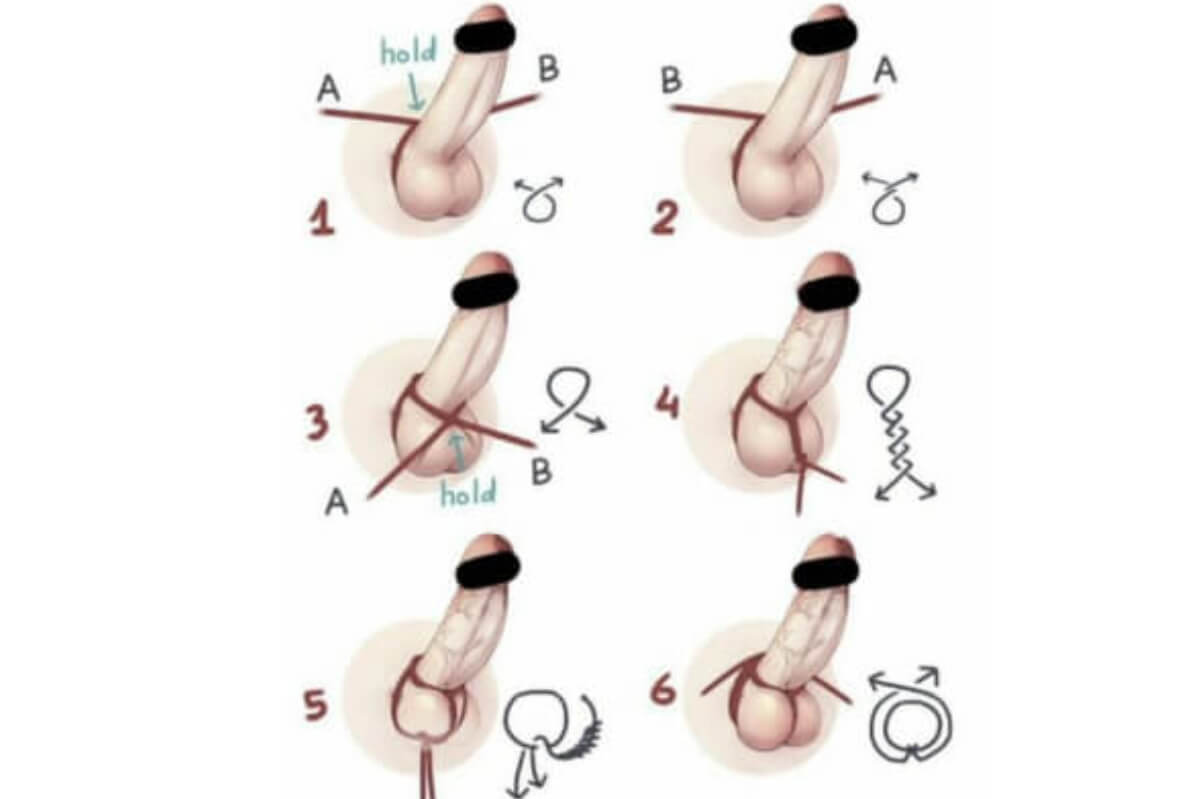
- Start at the scrotum. Lay the rope around the ball sack above the testicles and push them gently towards the perineum.
- Move to the shaft. Wrap the rope around it 2 or 3 times. Each wrap lies beside the previous one rather than on top of it, so the pressure spreads.
- Start loose. One finger should fit between rope and skin. You can always go tighter later, almost never looser.
- Secure with a figure-eight knot. It holds without tightening further under tension.
- Check. Colour, temperature, sensation. Ask him what he feels and look for yourself.
- Watch the clock. Untie after 20 to 30 minutes at the latest.
If you are unsure whether any of this appeals to you, test it with a cock ring first. If you like the harder erection when blood stays in your cock, rope is the next step.
How to tie your balls: what is different down there
Tying balls means wrapping the sack above the testicles so they are pushed downwards. It works differently from the shaft, because you are moving 2 organs on their cords rather than restricting flow inside erectile tissue. The sack gets wrapped above the testicles so they are pushed downwards and the skin pulls tight. That produces a dragging sensation many men describe as a reward in itself, and it has little to do with a hard cock.
Three things are different on the balls:
- The testicles stay mobile. The wrap sits on the neck of the sack, never across a testicle. Direct pressure on the testicle itself is how crush injuries happen.
- Twisting is an emergency. If a testicle rotates on its own cord, the blood supply is cut off. It announces itself as sudden severe pain on one side and needs medical help straight away.
- Weight is its own discipline. Ball stretching with weights is common on the sack and absent on the shaft. Combining both stacks 2 loads, so shorten the time accordingly.
How far this can go is covered in depth in the piece on cock and ball torture, usually shortened to CBT. The difference matters: in bondage the pleasure comes from the tie itself, in CBT it comes from the pain. 2 different games with 2 different sets of agreements.
Penis knots: which ones hold and which ones to avoid
3 knots cover everything a cock and ball tie needs, and picking the wrong one is the most common beginner mistake.
- The figure-eight knot secures the end of a wrap and does not tighten further under tension. This is the default for cock and ball ties.
- The half hitch holds a length of rope in position and opens again quickly. Useful for adjusting mid-scene.
- The tuck, where you simply push the rope end under the last wrap, needs no knot at all. It is the fastest to release and often the better choice for beginners.
What you avoid on genitals is any knot that tightens itself under load, meaning the whole family of slip knots and nooses. On an arm that is merely unpleasant. On a cock it is dangerous, because the thing pulling on the rope is usually an erection that is still growing. Step-by-step basics with pictures are in the guide to bondage knots.
Penis shibari
Shibari is the Japanese rope art in which the wrap itself becomes the image. On genitals the standard is the same as on the body: even wraps, cleanly laid lines, knots at defined points. There is no separate safety doctrine for genital shibari, neither in medicine nor in the scene. What exists is the general shibari canon plus the genital-specific risks listed above. The mindset behind it is covered in the piece on mindful rope work.
Why cock bondage feels so good
The appeal comes down to 3 effects: a harder erection, a more sensitive glans and the feeling of being handed over. You do not have to be into BDSM to want your cock tied. You do not even need a partner, because a bound dick is filthy fun while wanking too.
Restricted blood flow makes your cock harder while the glans gets more sensitive. Touch registers far more intensely. If you tend to come quickly, you buy yourself time, because a tied cock stays stiff for longer.
The third effect resists description, namely being handed over. A bound cock belongs to somebody else for the length of the scene. For many men that is the actual appeal, and it is precisely why the agreement comes first. The safety philosophy behind that is explained in the piece on RACK. RACK stands for risk aware consensual kink.
Frequently asked questions about cock bondage
What is cock bondage?
Cock bondage is tying the penis and scrotum with rope to restrict blood flow. The erection stays harder for longer and the glans becomes more sensitive. It is also called penis bondage, dick bondage or penis shibari. It differs from CBT in that the pleasure comes from the tie rather than from pain.
How do you tie a cock and balls?
For a combined tie the rope goes around the ball sack first, above the testicles, and the testicles are pushed gently towards the perineum. From there you take the rope to the shaft and wrap it 2 or 3 times, each wrap beside the last rather than on top of it. Secure it with a figure-eight knot. One finger should fit between rope and skin.
What knot should you use on a penis?
The figure-eight knot, because it holds without tightening further under tension. A half hitch works for holding a wrap in position, and simply tucking the rope end under the last wrap needs no knot at all. Avoid slip knots and nooses entirely, since a growing erection pulls them tighter on its own.
How long can you keep a cock tied?
The common scene figure is 15 to 30 minutes per round, then release completely. For cock rings, health portals give 30 minutes of wearing time followed by at least 60 minutes off. None of these numbers has been studied scientifically. A tie never stays on overnight or unsupervised.
Is it dangerous when your cock turns blue?
Blue means blood is flowing in but draining out poorly, so the tissue is still being supplied. The more serious finding is pale, whitish or blotchy skin together with coldness, which suggests no fresh blood is arriving. Untie in both cases, and immediately if there is pallor.
What can you use to tie a cock?
Cotton rope from around 5 mm upwards is the sensible choice. Cable ties are unsuitable because they only tighten, and so are parcel tape, duct tape, nylon cord and string. A pair of bandage shears with a blunt tip belongs within reach at all times.
When do you need a doctor?
When something persists after release: lasting numbness, discolouration that will not fade, growing swelling, or pain that intensifies. Sudden severe pain on one side of the scrotum is an emergency, because it can be testicular torsion. Metal rings that will not come off also belong in an emergency department straight away.